Collaborative Endorses Recommendations for a Restorative Restart
April 2021

As California school districts navigate transitions back to in-person schooling, they aim to serve students, families, and educators who have been deeply affected by the COVID-19 pandemic and the persistent effects of systemic racism. A new brief, developed and endorsed by student- and family-serving organizations across California, identifies a set of priorities for a restorative restart that build on lessons learned over the past year and put equity at the center of a return to school. The Collaborative has joined this coalition in supporting the brief because these priorities strongly echo and reinforce the lessons that have emerged from the Collaborative’s work throughout the pandemic, particularly a recognition that relationships and whole-person well-being are foundational components of a healthy and supportive learning environment. See the full brief and supporting materials at https://reimaginecaschools.org.
Collaborative Explores Ways in Which Combined Academic and Workplace Learning Can Advance Equitable Student Opportunities
February 2020
High school pathways seek to align coursework under a broad theme and provide access to rigorous academics and work-based learning in a way that offers both college and career preparation for all students. In December 2020, the California Collaborative on District Reform convened to explore pathways as a vehicle for equity, considering both the opportunities and the challenges associated with the approach. Meeting participants interacted with a range of partners in San Bernardino City Unified School District to explore the motivation for and promises of pathways work, the nature of learning opportunities in the workplace and the classroom, attention to equity in the design and implementation of pathways, and efforts to monitor progress over time. Resources from the meeting, including a summary of the group’s conversation, are now available on the California Collaborative’s website at https://cacollaborative.org/meetings/meeting40.
Collaborative Member and Staff Share LCFF Insights with Legislative Staff
December 2019

California Collaborative staff joined representatives from San José Unified School District (SJUSD) in a presentation about the Local Control Funding Formula (LCFF) to California legislative staff and advocates at the state capitol. Superintendent Nancy Albarrán and Deputy Superintendent Stephen McMahon shared their perspectives on implementing LCFF and their belief that LCFF is a major improvement from the previous funding system. They further described the district’s decision to dedicate supplemental funds to additional staff at their neediest schools, how the district supports teachers despite rising housing costs in the Silicon Valley, and their collaborative relationship with the teachers’ union. Collaborative Deputy Director Joel Knudson’s remarks added context to the body of knowledge about LCFF implementation and successes statewide, and staff member Marina Castro highlighted the Collaborative’s brief on SJUSD’s LCFF implementation that urged policy makers to consider alternative ways and purposes of achieving transparency.
Collaborative Work Featured at San José Teachers Association Conference
October 2019
A conference of San José Teachers Association (SJTA) school site representatives featured findings from the California Collaborative’s report, From Combat to Collaboration: The Labor-Management Partnership in San José Unified School District. The Collaborative’s deputy director, Joel Knudson, delivered a keynote address that placed the relationship between the district and the union in the context of high profile teacher strikes elsewhere in California in 2019. His remarks shared the history of labor-management interactions in San José—which once featured the same antagonistic levels of communication and behavior visible in other districts today—and the evolution over time to a partnership in service of shared goals. The presentation also highlighted some of the unique features of the relationship in San José and shared some of the advantages that district and union leaders experience by pursuing their work in a collaborative fashion.
California Collaborative Explores Ways to Build Cultures and Systems that Foster Effective Data Use
June 2019
Continuous improvement has pervaded education discourse across California and has influenced policy in a number of areas, including the state’s approach to supporting districts identified for “differentiated assistance.” Meanwhile, plans in the 2019 budget offer hope for expanding the statewide longitudinal data system. This development potentially takes continuous improvement work to a new level and creates an opportunity to explore local strategies in the context of state-sponsored approaches to collecting and using data. In June 2019, the California Collaborative on District Reform convened to explore data use in the context of continuous improvement. Meeting participants discussed the knowledge, skills, and cultures necessary to use data effectively as part of a thriving education system. They also considered the kinds of data systems that can support those cultures, including those planned at the state level. Resources from the meeting are available on the Meeting 39 page.
California Collaborative Explores Districts' Fiscal Constraints and Potential Approaches for Addressing Them
April 2019
Over the past decade, California schools have embraced fundamental policy changes that range from new academic standards to a transformed system of school finance, all in a context where a recovering state economy has contributed increasing revenues to K–12 education. Despite these promising developments, however, increasing costs and financial obligations make it difficult for districts to improve—or even maintain—the experiences they offer students and the working environments they create for adults in schools and school systems. In March 2019, The California Collaborative on District Reform convened to explore the sources of fiscal pressures, especially the ways in which multiple obligations combine to shape and constrain district options. Participants also examined potential opportunities for addressing these challenges through greater efficiency in district approaches, increasing the funds available to K-12 public education, and shifting the narrative about education systems’ fiscal situation. Resources from the meeting are available on the Meeting 38 page.
California Collaborative Deputy Director Joel Knudson writes Commentary about the Labor-Management Partnership in San Jose Unified
April 2019
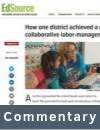
Ed Source published a commentary by California Collaborative Deputy Director Joel Knudson about San Jose Unified School District’s collaborative and productive relationship with the San Jose Teachers Association. In the wake of teacher strikes in Los Angeles and Oakland, Knudson draws attention to how the two sides in San Jose capitalized on opportunities for productive collaboration to create a partnership. More about the evolution of the relationship between the teachers association and the district can be found in the report From Combat to Collaboration: The Labor-Management Partnership in San Jose Unified School District, released by the California Collaborative on District Reform.
California Collaborative Shares Lessons about Mathematics with the SBE
March 2019
California Collaborative Deputy Director Joel Knudson joined the March 2019 meeting of the California State Board of Education to share lessons about mathematics teaching and learning that emerged from the Collaborative’s December 2019 meeting in Long Beach. Among the key areas of attention that come from both research and practice, Knudson discussed the need to explore problems in context; attend to the capacity needs of adults throughout the system; address structural barriers to equity; and ensure that systemic supports enable improvement at the classroom, school, and district levels. The presentation highlighted several examples from school districts that shared their work with Collaborative members in December. Following the presentation, Lori Grace of Twin Rivers Unified School District described her district’s comprehensive effort to transform mathematics in her district, sharing many of the practices and lessons learned that the Twin Rivers team had presented to Collaborative members in December..
California Collaborative Explores Challenges and Opportunities for Improving Instruction and Student Learning in Mathematics
January 2019
California school districts have long struggled to help their students reach high levels of skill and understanding in mathematics. Yet outcomes on both state and national assessments continue to reveal a combination of low overall performance, slow growth over time, and persistently large gaps among student groups. In December 2018, the California Collaborative on District Reform convened to unpack the challenges underlying these results and explore strategies for addressing them. Meeting participants considered evidence and strategies from a range of school districts. They discussed capacity issues including teacher content knowledge, administrator training and support, and school systems that facilitate improvement. Meeting conversation also examined approaches to equity that include course sequencing and placement decisions, and state policies that might support efforts at the local level. Resources from the meeting are available on the Meeting 37 page.
California Collaborative Explores MTSS and UDL as Strategies for Systemwide Success
July 2018
In June 2018, the California Collaborative on District Reform convened to explore how Sanger Unified School District has used MTSS to weave together multiple dimensions of improving student learning. The system in Sanger rests on a philosophy of early intervention and uses universal design for learning as the centerpiece of a base instructional program designed to meet the needs of all students. Through a culture of data use, a commitment to coherence at all levels of the system, and processes of ongoing reflection and refinement, the district demonstrates how MTSS can create opportunities for all children to thrive. Resources from the meeting are available on the Meeting 36 page
California Collaborative Explores the Strengths and Needs of California's ELs
June 2018
With nearly one quarter of California public school students classified as English learners (ELs), success in educating students across the state requires success in identifying and addressing the assets and challenges that ELs bring with them to a school setting. The California Collaborative convened for a two-day meeting to better understand what these strengths and needs are and how school systems can best enable ELs to thrive. Against the backdrop of the state's new EL Roadmap, which articulates an evolving and expanded commitment to recognizing and serving ELs, meeting participants explored issues related both to classroom instruction and to social and emotional learning considerations that can best position ELs for academic and life success. Resources from the meeting are available on the Meeting 35 page.
California Collaborative Convenes to Consider the Statewide System of Support
January 2018
Plans are well underway to develop a statewide system of support in California that, according to State Board of Education memos, will “assist LEAs and their schools to meet the needs of each student served, with a focus on building capacity to sustain improvement and effectively address inequities in student opportunities and outcomes.” The California Collaborative on District Reform convened for a two-day meeting to consider what such a system might entail. The group first considered what the field has learned about effective support through the lenses of research, practice, and continuous improvement. Based on these lessons, participants articulated a set of design principles that might guide an effective system of support. The group then turned its attention to current plans in California to learn about what existing proposals entail, reflect on the degree of alignment between that system and the principles established earlier in the meeting, and offer recommendations for how the state might move forward. Resources from the meeting are available below. Resources from the meeting are available on the Meeting 34 page.
Report Examines Transformation of the San José Unified District-Union Relationship
December 2017
It started with a cup of coffee. In the wake of an intense contract negotiation, and against the backdrop of a district bankruptcy, multiple teacher strikes, and a wave of mistrust that veterans of the era still refer to as “rock bottom,” the San José Unified superintendent and the San José Teachers Association president decided to chart a different path forward. A new report from the California Collaborative on District Reform, From Combat to Collaboration, explores the way in which the district and union laid the groundwork for a new way of working together, how leaders have continued to foster and deepen the partnership, the day-to-day policies and practices that allow the relationship to flourish, and how collaboration enables the district to better serve its students. The report concludes with a set of lessons that can inform other districts and unions seeking to develop a more productive relationship.
For more information about San José Unified, please visit the Meeting 30 page.
Brief Explores an Alternative Approach to Overcoming LCAP Flaws
July 2017
The Local Control Funding Formula (LCFF) has introduced positive and much-needed change to California’s approach to K-12 education funding by allocating resources according to student need and freeing districts to make decisions that address local priorities. For all of LCFF’s advantages, however, the Local Control Accountability Plans (LCAPs) in which districts articulate their programmatic and spending decisions have received criticism for being archaic, cumbersome, difficult to complete, opaque, and incoherent. This brief, written in partnership with Pivot Learning, is the fifth in a series from the California Collaborative exploring key issues of LCFF implementation, and it describes an alternative approach to solving policy problems. The brief shares four prototypes that emerged from a November 2016 design sprint as new approaches to achieving LCFF goals. By embracing user-centered design, California’s education leaders have an opportunity to overcome flaws in the LCAP, fulfill the potential of LCFF, and preserve the funding system through the upcoming statewide elections and into the future.
For more information about LCFF, please view the resources on the Meeting 29 and LCFF pages of the California Collaborative website.
California Collaborative Convenes to Explore the State’s K-12 Education Landscape
June 2017
Changes at the federal level and an upcoming California election are shaping the social, economic, and political context in which K-12 districts operate. The California Collaborative on District Reform convened for a two-day meeting to step back, reflect, and take stock of the road ahead. Meeting participants listened to research-based presentations that helped to illustrate the postsecondary world that schools are preparing students for, who those students are and what their challenges will be, and how much money school systems are likely to have to address those challenges and ensure student success. A set of working groups then explored the high priority challenges facing districts in three domains: (1) the instructional core (the interaction of teachers and students around content); (2) external factors that influence students’ abilities to engage in academic learning during their K-12 experience and to thrive after high school graduation; and (3) financial constraints and opportunities related to revenues, obligations, and investment priorities. Participants then considered issues of capacity, including the strategies and systems of support needed at the state and local levels to understand and effectively develop cultures and practices of continuous improvement. Resources from the meeting are available on the Meeting 33 page.
California Collaborative Convenes to Explore Strategies for Leveraging Partnerships to Improve Community Outcomes through Collective Impact
May 2017
The current context of political uncertainty, social and governmental discord, and potential funding cutbacks make it more important than ever for organizations to work together in service of what is best for our youth. With that in mind, Leveraging Partnerships to Improve Community Outcomes: Collective Impact examined collective impact as a strategy for advancing progress toward broadly held community goals. Meeting participants explored possible motivations for a wide range of community partners to work together across organizational lines and what those various roles can entail. They also discussed shared measurement systems that can engage and inform cross-organization collaboration. Participants had further opportunities to consider key challenges related to selecting and supporting a backbone organization to organize collective impact work, securing funding to sustain joint efforts, and clarifying the roles of and securing commitments from partners to leverage the contributions of multiple organizations toward shared goals. These resources are available on the Meeting 32 page.
California Collaborative Convenes to Explore Strategies for Integrating Academics and SEL to Advance Equity and Achievement
December 2016
The California Collaborative on District Reform convened in Oakland for a two-day meeting, Integrating Academic, Social, and Emotional Learning to Advance Equity and Achievement. The meeting explored methods to support and integrate academic, social, and emotional learning in K-12 education. Implementation efforts surrounding the Common Core State Standards have frequently addressed the knowledge and skills needed for academic success. The interpersonal and intrapersonal competencies embodied through social and emotional learning (SEL), however, are often preconditions for academic engagement, and represent critical skills for career and civic success beyond the classroom. Discussion during the meeting explored ways in which school districts can integrate SEL with academic efforts to best position students to thrive in and out of school. Participants received a briefing book of resources and literature that included information about the Oakland context, research and policy about SEL, current SEL progress in Oakland Unified School District (OUSD), information about OUSD’s SEL instruction and curriculum, strategies for how to transform adult behavior and culture, equity and SEL, and how to assess and report SEL competencies.These resources are available on the Meeting 31 page.
California Collaborative PACCCRAS Members Contribute to a Letter to State Board
August 2016

The Promoting Authentic College, Career, and Civic Readiness Assessment Systems (PACCCRAS) Working Group, which aims to leverage the diversity of perspectives and insights of its members to inform the evolution of a new statewide accountability system has written a letter to the State Board of Education. In it, committee members urge the State Board to (1) build a system that allows for growth and change over time and (2) recognizes and shares the innovative work that is already being done by some districts. This letter was shared at a State Board meeting.
California Collaborative Releases a New Brief Offering LCAP Communication Guidelines
July 2016
As they continue to implement the Local Control Funding Formula (LCFF), California educators find themselves struggling to communicate district plans to parents, teachers, and other members of the school community. To help inform the community about districts’ plans and results, many districts voluntarily produced supplementary materials to accompany their 2015 Local Control Accountability Plan (LCAP). Following suit, the State Board of Education is considering “executive summaries” as one solution to effectively inform the public. But what does a good executive summary or other outreach approach look like? This brief, the fourth in a series from the California Collaborative exploring key issues of LCFF implementation, identifies some guidelines for district leaders to make their plans more accessible.
For more information about LCFF, please view the resources on the Meeting 29 and LCFF pages of the California Collaborative website.
California Collaborative Convenes to Explore Strategies for Developing a Comprehensive Human Capital System
May 2016
The California Collaborative on District Reform convened in San José on May 12 and 13 for a two-day meeting, Ensuring Equitable Access to High Quality Teaching: Human Capital in San José. The discussion explored key strategies that districts use to develop comprehensive human capital systems to improve student learning opportunities and meet equity goals. The meeting explored issues of district culture and the ways in which strong relationships make growth possible. It also examined the possibilities for districts to design teacher leadership roles to attract, retain, and reward strong teachers and give traditionally disadvantaged students access to quality teachers. Finally, meeting participants considered possible changes to state policy under which districts and their labor partners might approach issues of tenure, evaluation, and dismissal to better meet shared goals. Participants received a briefing book of resources and literature that included information about the San José context, challenges that stand in the way of professional culture and quality, systems that can support quality teaching and access to it, and the policy context for human capital reform. These resources are available on the Meeting 30 page.
California Collaborative Releases a New Brief Identifying Potential Solutions to Key LCAP Challenges
January 2016
The Local Control Accountability Plan (LCAP), a state-required document in which districts describe their goals, their strategies to achieve these goals, and the resources allocated to support these strategies, is a central component of California’s Local Control Funding Formula (LCFF). Having completed two rounds LCAP submissions, district leaders and others around the state have learned much about what the process entails, where it has created the conditions for improved practices and outcomes, and where obstacles remain. This brief, the third in a series from the California Collaborative exploring key issues of LCFF implementation, outlines the key challenges undercutting the LCAP’s effectiveness and offers short term and long term solutions to these identified challenges.
For more information about LCFF, please view the resources on the Meeting 29 and LCFF pages of the California Collaborative website.
California Collaborative Convenes to Explore Ways to Refine the LCAP Process and Template
December 2015
The California Collaborative on District Reform convened on November 12 and 13 in Sacramento for a two-day meeting, Fulfilling the Promise of LCFF: Improving the LCAP. At the request of State Board of Education (SBE) President Mike Kirst, the Collaborative examined the current state of the Local Control Accountability Plans (LCAP) and worked towards recommendations for improvement. The meeting highlighted challenges that districts and others have encountered in the LCAP development and approval process and identified some potential solutions to those challenges. It also examined ways in which districts might more effectively communicate about the LCAP with community members. To close the meeting, participants discussed ways that the SBE can facilitate more clarity and consistency in the messaging and supports that districts receive from the county offices of education. Participants received a briefing book of resources and literature that included analyses of early LCAP efforts, approaches to strategic planning, background on LCFF and the ongoing evolution of the LCAP, and example materials that districts have developed to communicate to their communities. These resources are available on the Meeting 29 page.
Collaborative Writes a Letter to SBE and CDE about Smarter Balanced Experiences
July 2015
The California Collaborative’s June 2015 meeting in Whittier Union High School District gave district leaders the opportunity to provide feedback on the first official administration of California’s new Smarter Balanced assessments in English language arts and mathematics. Overall, meeting participants expressed support for the new assessment system as a significant advance over previous state tests. At the same time, those present recognized that the state is in the early stages of a learning process and offered several suggestions to improve assessment administration and reporting. Meeting guest Ilene Straus, vice president of the State Board of Education (SBE), encouraged the California Collaborative to compile relevant feedback to share with the SBE and California Department of Education. This letter highlights some of the key points that emerged in the meeting conversation. For more details about the discussion, please view our Meeting Summary.
California Collaborative Convenes to Explore Ways in Which Assessment Practices & Teacher Leadership Can Facilitate Implementation of the Common Core
July 2015
The California Collaborative on District Reform convened in Whittier on June 18 and 19 for a two-day meeting, Assessment and Teacher Leadership in the Transition to the Common Core. The Collaborative visited a high school district for the first time, using the context of secondary education as a springboard to explore an evolving area of practice: district-developed common assessments and teacher leadership as vehicles for implementing the Common Core and improving student learning opportunities. The meeting also examined the integration of these efforts with two key state policy developments, the first Smarter Balanced summative assessment administration and the ongoing process of districts’ Local Control Accountability Plans (LCAPs). Participants received a briefing book of resources and literature on the Whittier Union High School District context, types and purposes of various assessments, and approaches to teacher leadership. These resources are available on the Meeting 28 page.
California Collaborative Shares Lessons about Cross-District Collaboration with CCEE Board
June 2015
California Collaborative Chair Jennifer O’Day joined the June 2015 board meeting of the California Collaborative on Educational Excellence (CCEE) to present lessons learned from the California Collaborative on District Reform’s ten years of collaborative inquiry. O’Day highlighted the need for a systemic approach to solve education’s largest problems, the need for adaptation and flexibility when developing solutions that impact varied districts, and the power of collective learning borne from collaboration linked to specific challenges. As the CCEE explores ways of supporting struggling districts, O’Day advised that it take these lessons and focus on continuing its investigation on effective systems of support, building its own capacity, identifying appropriate tools and resources to support struggling districts, and demonstrating that the push for compliance-based systems is slowly dissipating in favor of continuous improvement and support. In addition to O’Day’s presentation about lessons from the California Collaborative on District Reform, Collaborative members Michael Hanson, Rick Miller, and Chris Steinhauser spoke to the CCEE board about lessons they have learned through their experiences with the CORE districts.
Informing the CCEE: Lessons from the California Collaborative on District Reform [slides]
A webcast of this CCEE Board meeting streams Dr. O’Day’s presentation at 2:49:30 [video]
California Collaborative Convenes to Address Accountability & Supports in a System of Continuous Improvement
March 2015
The California Collaborative on District Reform convened on March 5 and 6 in Fresno for a two-day meeting, Accountability and Support in a Coherent System of Continuous Improvement. The meeting examined issues of alignment in connecting goals with various accountability mechanisms that include the Local Control Accountability Plan, the single plan for student achievement, and the California Office to Reform Education waiver. Keeping these issues in mind, meeting participants explored metrics that district can use to examine progress towards goals, with particular attention to a robust data system developed within Fresno Unified School District (USD) to monitor progress and provide actionable information to principal, counselors, and other educators. Discussion then turned to ways in which systems like the one in Fresno can contribute to a broader system of continuous improvement from the central office to the school and ultimately to the classroom level. Participants received a briefing book of resources and literature on the Fresno USD context, ways of identifying and displaying data, and establishing the conditions for an effective statewide accountability system. These resources are available on the Meeting 27 page.
New Brief Revisits Key Lessons from California’s CLAS Experience
March 2014
California’s new state assessment is just around the corner. As the first administration of the California Assessment of Student Performance and Progress (CAASPP) approaches, educators are preparing teachers, students, and parents for a fundamental component of the statewide transition to the Common Core State Standards. As they do so, an opportunity exists to build on the success and avoid the pitfalls of a similar assessment system that the state briefly adopted two decades ago. A new brief from the California Collaborative on District Reform, Still Learning from the Past: Drawing on California’s CLAS Experience to Inform Assessment of the Common Core, updates key lessons from the California Learning Assessment System of the early 1990s that we originally identified in a September 2012 brief called Learning from the Past. It chronicles the important progress that has taken place over the past two years while highlighting critical areas for continued attention as California transitions to the CAASPP. Through careful attention to these lessons, educators across the state can better position themselves to fulfill the promises of the Common Core.
For more resources from the California Collaborative about the Common Core State Standards, including the original Learning from the Past brief, please visit http://cacollaborative.org/topics/common-core-state-standards.
California Collaborative Deputy Director Explains the Benefits of District Collaboration
December 2014

The California Collaborative on District Reform is one example of a growing trend of cross-district collaboration in which K-12 education systems leverage peer-to-peer networks to accelerate their growth. In a new video for the American Institutes for Research’s Long Story Short series, California Collaborative Deputy Director Joel Knudson describes this emerging approach to district capacity building. The video summarizes some of the advantages that collaboration creates in the quest to improve student learning.
California Collaborative Convenes to Address the Common Core in Mathematics
December 2014
The California Collaborative on District Reform convened on December 17 and 18 in Sanger for a two-day meeting, Implementing the Common Core in Mathematics: Designing, Supporting, and Monitoring High Quality Instruction. The meeting explored some of the particular challenges facing districts as they embrace the new mathematics standards. Among these are developing an understanding of what instruction should look like in a Common Core environment and finding ways to monitor progress toward that goal, building teacher content knowledge to create quality student learning environments, designing course pathways that enable all students to access and master mathematics content, and navigating the wide array of available instructional materials to most effectively support classroom instruction. Participants received a briefing book of resources and literature on the Sanger context, high quality mathematics instruction, tools for assessing instruction, course access and sequencing, and developing teacher content knowledge. These resources are available on the Meeting 26 page.
California Collaborative Releases a New Brief Identifying LCFF Capacity-Building Needs
November 2014
California’s Local Control Funding Formula (LCFF) has introduced changes that alter the conditions under which educators, administrators, and community leaders approach their roles in the K-12 education system. Consequently, leaders at all levels may need to build the capacity—both the knowledge and skills and the resources—that they need to fulfill the potential of the new funding formula. This brief, the second in a series from the California Collaborative exploring LCFF implementation issues, highlights some of those capacity needs. Recognizing and addressing the demands for improved capacity at all levels of the system will be essential for achieving success with the new funding system.
California Collaborative Convenes to Explore Issues of Professional Capital in Common Core Implementation
July 2014
The California Collaborative on District Reform convened in Garden Grove on July 15-16 for a two-day meeting, Professional Capital in a Time of Transition: Moving to the Common Core in Garden Grove. The meeting used the framework of professional capital—the combination of human, social, and decisional capital—and the experiences of Garden Grove Unified School District (GGUSD) to explore issues of capacity building for Common Core implementation. Discussions focused on the district’s efforts to establish a strong foundation of success for its students as teachers, principals, and district leaders face challenges in their transition to Common Core instruction, including teacher motivation, school leadership, and communication, both within Garden Grove and across the state. Participants received a briefing book of resources and literature on the GGUSD context, the professional capital framework, understanding and addressing teacher motivation, and positioning the state to best support Common Core implementation. These resources are available on the Meeting 25 page.
For more information and resources about the Common Core State Standards, please view the Common Core State Standards page of the California Collaborative website.
California Collaborative Releases a New Brief Identifying Early LCFF Lessons
July 2014
The Local Control Funding Formula (LCFF) represents a fundamental transformation of the way California allocates state funds to school districts and the ways the state expects districts to make decisions about (and report on) the use of these funds. This brief identifies some early lessons about how best to use the new system to meet student needs, especially the traditionally underserved. It highlights key areas that merit attention from California education stakeholders, as well as issues of communication around priorities and expectations that can help support the successful enactment of the new funding policy.
For more information about LCFF, please view the resources on the Meeting 24 and LCFF pages of the California Collaborative website.
Lessons from the Collaborative’s Work Highlighted at PACE Common Core Event
June 2014
A conference hosted by Policy Analysis for California Education (PACE) highlighted key themes that have emerged from the California Collaborative over its four years of engagement with the Common Core State Standards. Joel Knudson, deputy project director of the California Collaborative, spoke on a panel that addressed the question, “Can Common Core State Standards transform teaching and learning?” Though the Common Core can play an important role in transforming education and learning, Knudson argued that standards alone will not produce the improvements we seek. The Collaborative has consistently emphasized the need for capacity building to facilitate adult learning throughout this shift. Additionally, strategic and proactive communication is necessary not only to facilitate improvements in classroom instruction, but to build a constituency of support that can sustain the Common Core effort throughout the implementation process. Finally, Collaborative members advocate for increased collaboration among stakeholders at all levels to build collective knowledge and accelerate the learning process during this time of transition, and argue that Common Core ought to be the top priority for California education.
Click here to view the conference video recordings on the PACE website.
California Collaborative Convenes to Address LCAP Development
April 2014
The California Collaborative on District Reform convened on April 2 and 3 in Los Angeles for a two-day meeting, Developing the LCAP: Engaging Communities, Aligning Strategies. The meeting explored many of the concrete issues districts are facing in the process of developing their Local Control Accountability Plans (LCAPs), including the call to meaningfully engage community members, the importance of achieving coherence between the LCAP and other strategic planning efforts, and the demands for improved capacity at all levels of the education system to fulfill the promises of the Local Control Funding Formula. Participants received a briefing book of resources and literature on the Los Angeles Unified School District context, alignment of reform strategies and resource allocation, approaches to meaningful community engagement, and strategies for school-level budgeting. These resources are available on the Meeting 24 page.
California Collaborative Releases a New Brief on Common Core Implementation in Sacramento City USD
March 2014
As district leaders search for the best ways to improve student learning with the Common Core State Standards, some early implementers are giving us an opportunity to learn from their experience. This brief describes Sacramento City Unified School District’s approach to developing units of study that guide teachers’ classroom practice. The units provide a valuable tool for designing curriculum and instructional materials, but just as importantly, they have driven teacher capacity building and engagement teachers in the implementation of the new standards. The brief examines the units of study strategy as it has unfolded in Sacramento, identifies some of the key points of evolution since the district began its work three years ago, and discusses some of the challenges and tensions facing districts that might employ a similar approach.
For more information about SCUSD and Common Core implementation, please view the resources on the Meeting 23 and Common Core pages of the California Collaborative website.
California Collaborative Co-Sponsors Symposia on Common Core Implementation
February 2014
The California Collaborative on District Reform co-sponsored a pair of symposia called Moving Forward with Common Core State Standards: Fostering a Learning Culture for English Learners and their Teachers, one held in Irvine on February 25 and the other held in Oakland on February 26. The event brought together district leaders and other stakeholders from across the state and used a combination of presentations and breakout sessions to examine the latest research, resources, and best practices to support English Learners (ELs) within the context of CCSS implementation, including state-sponsored tools, frameworks, and professional learning modules. The symposium featured contributions from two Collaborative members. Aída Walqui, Director of the Teacher Professional Development Program at WestEd, delivered a keynote address and gave two presentations on the use of formative assessment with ELs. Bill Honig, chair of the California Department of Education’s Instructional Quality Commission, gave a presentation on California’s draft English Language Arts/English Language Development Curriculum Framework. REL West and California Education Partners partnered with the California Collaborative to co-sponsor the event. These organizations co-sponsored similar symposia focused on other elements of Common Core implementation in August 2012, June 2013 and November 2013.
California Collaborative Work Presented at CERA Conference
December 2013
Presentations at the California Educational Research Association (CERA) conference on December 5th and 6th highlighted recent publications from the California Collaborative. The first presentation drew parallels between Common Core assessment efforts and a similar initiative that took place in California two decades ago, the California Learning Assessment System (CLAS). The session highlighted key findings from the Collaborative’s brief Learning from the Past: Drawing on California’s CLAS Experience to Inform Assessment of the Common Core and identified key lessons for educators leading Common Core implementation efforts today. A second presentation shared findings from the Collaborative’s new report You’ll Never Be Better Than Your Teachers: The Garden Grove Approach to Human Capital Development, including the comprehensive and interrelated set of strategies used in Garden Grove to improve the quality of classroom instruction. Joel Knudson, Deputy Director of the California Collaborative and author of these products, delivered both presentations.
Learning from the Past: CLAS and the Common Core [CDE/CISC slides]
California Collaborative Convenes to Address Common Core Implementation
November 2013
The California Collaborative on District Reform convened on November 21 and 22 in Sacramento for a two-day meeting, Leveraging Opportunities for Instructional Excellence: Implementing the Common Core. The meeting explored many of the opportunities and challenges facing California districts as they integrate the Common Core into classroom instruction, including the development and use of curriculum and instructional materials, capacity building efforts for teachers and leaders, shifts required at all levels of our K-12 systems, and identification and allocation of resources to support the work. Discussion focused on Sacramento City Unified School District’s (SCUSD) efforts—including an exploration of the district’s teacher-developed units of study and a conversation with a panel of principals and teachers—to address implementation issues facing all districts. Participants received a briefing book of resources and literature on the SCUSD context and its approach to developing units of study, instruction for English learners within the Common Core, professional learning around the Common Core, and efforts to leverage resources and align systems in support of Common Core implementation. These resources are available on the Meeting 23 page.
California Collaborative Co-Sponsors Symposia on Technology and the Common Core
November 2013
The California Collaborative on District Reform co-sponsored a pair of symposia called Moving Forward with Common Core State Standards: Harnessing the Power of Technology, one held in San Jose on November 12 and the other held in Los Angeles on November 14. The events featured a keynote address from Rushton Hurley about inspiring teachers with technology. Subsequent breakout sessions shared tools for educators to use in classrooms and lessons learned from districts and counties through their efforts to integrate technology and Common Core implementation. REL West and California Education Partners partnered with the California Collaborative to co-sponsor the event. These organizations co-sponsored similar symposia on Common Core implementation in August 2012 and June 2013.
California Collaborative Releases a New Report on Improving Teacher Quality
September 2013

Teachers matter. Educators, policymakers, and the general public alike agree that great teachers are vital to a thriving K-12 education system, yet the pathways to assembling a high quality teaching force remain elusive. This case study of Garden Grove Unified School District, winner of the 2004 Broad Prize for Urban Education, demonstrates what a comprehensive approach to maximizing teacher quality can look like in practice. The report examines the strategies behind the district’s two key levers for improvement: (1) getting the best teachers and (2) building the capacity of the teachers it has. The story of Garden Grove is less about what it does, however, than how the district approaches its work. The report therefore explores the district culture and commitment to continuous improvement that produce effective practices of human capital development and enable these practices to achieve success.
California Collaborative Convenes to Address Special Education
June 2013
The California Collaborative on District Reform convened on June 27 and 28 in San Francisco for a two-day meeting, Roots, Reality, and Reboot: Transforming (Special) Education to Advance Equity and Learning. The meeting explored the historical roots of special education in the United States, as well as current practices of identification and instruction that disproportionately funnel students of color and English learners into special education services and inferior educational opportunities. Meeting participants then had an opportunity to explore the ways in which school systems can establish the conditions for more equitable educational opportunity, including instructional approaches that can meet the needs of a wide range of learners in inclusive settings. All meeting participants received a briefing book of resources and literature on the history of special education, patterns of disproportionality, cutting edge instructional practices (including the Universal Design for Learning framework), and special education policy in California. These resources are available on the Meeting 22 page.
California Collaborative Co-Sponsors Symposium on Common Core Implementation
June 2013
The California Collaborative on District Reform co-sponsored a symposium on June 25 and 26 in Los Angeles called Moving Forward: Common Core State Standards Implementation and Assessment. The event, which brought together district leaders and other stakeholders from across the state, used a combination of presentations and breakout sessions to examine the instructional shifts called for in the Common Core, emerging practices for effective implementation, and opportunities for collaboration that can facilitate a successful transition to the Common Core. The symposium featured contributions from Collaborative members, including a keynote address from Jonathan Raymond, Superintendent of Sacramento City Unified School District, and a presentation from Rose Owens-West, Director of the Region IX Equity Assistance Center at WestEd, about key considerations to ensure that educators meet the needs of all learners as the Common Core are implemented. In addition, Joel Knudson, Deputy Director of the Collaborative, presented findings from the Collaborative’s recent brief, Learning from the Past: Exploring California’s CLAS Experience to Inform Assessment of the Common Core. REL West and California Education Partners partnered with the California Collaborative to co-sponsor the event. These organizations co-sponsored a similar symposium in August 2012 in Northern California.
Events Addressing Assessment and the Common Core Feature the Collaborative’s Learning from the Past Brief
June 2013
Three recent events addressing assessment and the Common Core featured one of the Collaborative’s recent briefs, Learning from the Past: Exploring California’s CLAS Experience to Inform Assessment of the Common Core. Student assessment is a high priority for school districts as they transition to the Common Core State Standards, but this is not the first time that California has embraced an effort to use more authentic means to assess student learning. Joel Knudson, Deputy Director of the Collaborative, led sessions at two events to identify key lessons learned from assessment experiences of the early 1990s: a joint meeting of the California Department of Education and the California Curriculum and Instruction Steering Committee and a symposium on Common Core implementation and assessment gave educators from the county and district levels an opportunity to identify ways in which the CLAS experience can inform their current implementation efforts. Joel also contributed to a webinar hosted by the Regional Educational Laboratory-West that featured the Collaborative’s work around CLAS as well as efforts currently underway in California Office to Reform Education (CORE) participating districts to develop and pilot classroom-level assessment modules. Ben Sanders, the Director of Standards, Instruction, and Assessment at CORE, shared a systemic approach to developing these assessment modules, followed by a panel of teachers who described the ways in which these efforts have informed their classroom practice.
Assessment of the Common Core State Standards: Lessons Learned and Promising Practices [webinar]
Learning from the Past: CLAS and the Common Core [CDE/CISC slides]
California Collaborative Convenes to Address a Systemic Approach to Creating Community Schools
April 2013
The California Collaborative on District Reform convened on April 11 and 12 in Oakland for a two-day meeting, Creating a Quality Community Schools District: Each Child College, Career, and Community Ready. The meeting used the Oakland Unified School District as a lens to explore the relationship between school districts and their communities and the ways in which systems address the needs of the whole child. Meeting participants also engaged in conversation about comprehensive school reviews that can provide evidence of quality to schools and their surrounding communities while motivating concentrated efforts at improvement. All meeting participants received a briefing book of resources and literature on community schools, measurements of school quality, restorative justice practices, and a proposal from the California Office to Reform Education (CORE) for a new approach to achieving quality and accountability. These resources are available on the Meeting 21 page.
Collaborative Members Support Local Control Funding Formula
April 2013
Eight superintendents on the California Collaborative on District Reform, as well as the chair of the group, wrote a letter urging Joan Buchanan, the chair of the Assembly Education Committee, to pass the Local Control Funding Formula (LCFF) in the budget this year. They argue that the current accountability system is undermined with over-regulation and cumbersome bureaucracy that impedes districts’ ability to develop coherent educational approaches. Under LCFF, all students would receive equal access to a base level of funding, with special attention paid to how we fund low-income students, English learners, and students in foster care. The letter argues that LCFF will create an education finance system with increased local flexibility and transparency so that district and school staff can focus directly on improving education outcomes and ensure that students drive the allocation of resources.
California and the Common Core State Standards: Early Steps, Early Opportunities
February 2013
This brief stems from the symposium Collaborating for Success: Implementing the Common Core State Standards in California co-hosted by the California Collaborative in August 2012. It provides an overview of the promises and challenges of implementing the Common Core State Standards (CCSS) as discussed at the symposium by several national experts. In particular, California Collaborative member, Kenji Hakuta, emphasized the importance of linking English language development with content. The brief presents themes which emerged from conversations among district leaders about their strategies for and experiences with implementing the CCSS. Themes include strategies for communicating the CCSS vision to various audiences, aligning resources, tools, policies, and practices to support CCSS implementation, and building partnerships with community organizations such as afterschool providers. The report concludes with a discussion of next steps in California’s transition to the CCSS including the need to ensure equity and access for all students as well as navigating the state's upcoming transition to a new accountability system.
California Collaborative Convenes to Address 21st Century Learning for All: Closing Opportunity Gaps
January 2013
On January 10-11th the California Collaborative convened to hear about San Jose Unified School District’s work to foster 21st Century learning and close opportunity gaps, as laid out in the district’s new strategic plan and key performance measures. The meeting provided an opportunity to examine exactly what 21st Century skills are and how educators can best foster them and capture evidence of student mastery. Attendees grounded discussion around identifying and measuring opportunity gaps in opportunity- to- learn artifacts submitted by our member districts. In addition to this discussion of district-level strategies, the convening explored two critical issues of state policy: potential indicators that could be incorporated into a revised state accountability system and the move toward a revised school finance system in California. Additional resources on these topics are available on the Meeting 20 page.
Collaborative Members Join Governor’s Working Group on School Finance Reform
November 2012

In November of 2012, members of the California Collaborative on District Reform (CCDR) joined many district officials from urban, suburban and rural areas and statewide advocacy groups in an invitation-only series of working group sessions on the weighted pupil formula. Representatives from the Department of Finance, State Board of Education, and the California Department of Education hosted the working group to gather feedback from stakeholders on key WPF design and implementation issues and on what changes, if any, need to be made to the accountability system to shift from a compliance-oriented system to one focused on ensuring all kids are college and career ready.
Nine of ten districts in the Collaborative participated as key stakeholders, providing invaluable examples to inform the resource allocation and accountability discussions. Representatives from Fresno Unified School District (FUSD) shared their vision of an accountability system that focused on better measures of student performance in accountability, such as college-and-career readiness measured for students in upper grades. FUSD currently has a metric for college-and-career readiness at the upper grade levels that informs how they target resources and interventions for students in the upper grades that are falling behind. CCDR representatives, Jennifer O’Day, Jeimee Estrada and Joel Knudson attended the working group sessions as part of the Collaborative’s efforts to work with district leaders to gather examples of funding allocation practices at the local level and guiding principles for the state to consider as state representatives seek to overhaul the school funding system.
The following CCDR members were invited and/or participated:
Jennifer O’Day, Chair
California Collaborative on District Reform
Mike Hanson, Superintendent and Ruth Looney, Chief Financial Officer
Fresno Unified School District
John Deasy, Superintendent; Matt Hill, ; and Megan Reilly, Chief Budget Officer
Los Angeles Unified School District
Jonathan Raymond, Superintendent
Sacramento City Unified School District
Thelma Melendez de Santa Ana, Superintendent and Michael Bishop, Chief Financial Officer
Santa Ana Unified School District
Tony Smith, Superintendent and Vernon Hall, Deputy Superintendent of Business and Operations
Oakland Unified School District
Christopher Steinhauser, Superintendent and Jim Novak, Chief Financial Officer
Long Beach Unified School District
Marc Johnson and Eduardo Martinez, Chief Budget Officer
Sanger Unified School District
Vince Matthews, Superintendent
San Jose Unified School District
Richard Carranza, Superintendent
San Francisco Unified School District
Derry Kabcenell
Dirk & Charlene Kabcenell Foundation
Arun Ramananthan, Executive Director
Education-Trust West
California Collaborative Work Presented at CERA Conference
November 2012
Presentations at the California Educational Research Association conference on November 29th and 30th highlighted work done by the California Collaborative. Over the past four years, the Collaborative has documented a learning partnership between Fresno and Long Beach Unified School Districts and is beginning a study of an emerging mentoring relationship between Garden Grove and Oakland Unified School Districts. Stephanie Hannan of the American Institutes for Research presented findings from the documentation of the Fresno-Long Beach Learning Partnership and Joel Knudson, Deputy Director of the Collaborative, discussed lessons from the Garden Grove and Oakland relationship. Soung Bae, Director of Research and Learning at California Education Partners, discussed the California Office to Reform Education (CORE). CORE is an organization which seeks to raise student achievement by promoting collaboration and learning between its eight member districts, seven of whom are also members of the Collaborative. Helen Duffy, task leader of the documentation of the Fresno-Long Beach Learning Partnership, synthesized lessons across these three instances of district collaboration.
The Fresno-Long Beach Learning Partnership [slides]
Mentoring for System Improvement: Lessons from an Emerging District Partnership [slides]
Learning from the Past: Drawing on California’s CLAS Experience to Inform Assessment of the Common Core
September 2012
As California approaches a new system of academic standards, instruction, and assessment, it enters familiar territory. The use of multiple modes of assessment, tight alignment between assessments and expectations for student learning, and a focus on assessment for formative (as well as summative) purposes—all with an emphasis on students’ understanding and ability to apply their learning—mirror the state’s priorities as it transitioned to the California Learning Assessment System (CLAS) in the early 1990s. This policy and practice brief examines the CLAS experience to identify lessons for districts as they implement the Common Core today. Through these lessons, districts across the state might build on promising practices from two decades ago while avoiding some of the pitfalls that undermined the CLAS effort.
California Collaborative Co-Sponsors Symposium on Common Core Implementation
August 2012
The California Collaborative on District Reform co-sponsored a symposium on August 14 and 15 called Collaborating for Success: Implementing the Common Core State Standards in California. The event, which brought together district leaders and other stakeholders from across the state (including 32 California school districts), used a combination of addresses and breakout sessions to examine the instructional shifts called for in the Common Core, emerging practices for effective implementation, and opportunities for collaboration that can facilitate a successful transition to the Common Core. The symposium also featured contributions from several Collaborative members, including a panel of early implementers that included Long Beach USD Superintendent Chris Steinhauser, remarks from San Francisco USD Superintendent Richard Carranza and Stanford professor Kenji Hakuta about the ways in which the Common Core addresses language demands for English learners, and closing observations from State Board of Education President Mike Kirst. REL West, the California Comprehensive Center at WestEd, and California Education Partners partnered with the Collaborative to co-sponsor the event.
California Collaborative Convenes to Address School and District Leadership
June 2012
The California Collaborative on District reform convened on June 28 and 29 in Fresno for a two-day meeting, Leadership for Change: Finding & Developing 21st Century School Leaders. In the context of changing expectations for students and the education systems that serve them, the meeting addressed the demands these changes introduce for district- and site-based leadership. Participants engaged in conversation to better articulate the skills that 21st century school leaders need, as well as to explore the challenges of building leadership capacity through recruitment, development, and succession planning. All meeting participants received a briefing book of resources and literature on leadership skills and traits, leadership development, leadership recruitment and succession, assessing leadership performance, and specific contextual information and problems of practice through which Collaborative districts are approaching the challenge of expanding leadership capacity. These resources are available on the Meeting 19 page.
Building District Capacity for Data Informed Leadership
June 2012
This fourth and final brief about the Fresno-Long Beach Learning Partnership looks at the ways that two districts push one another to deepen the culture of data use within and across districts, address infrastructure challenges and provide support as they navigate public conversations about student outcomes. This example of collaboration can inform schools and districts across the country as they develop tools and processes to access and use data for decision making. The brief demonstrates how two districts are building their collective capacity to look at student outcomes and leading indicators such as course transcripts and formative assessment scores to uncover root causes for achievement patterns and develop solutions to common challenges.
This brief concludes the series documenting the Fresno-Long Beach Learning Partnership. For an overview of the series and a summary of key themes and implications, please visit the link below.
California Collaborative Urges State to Move Forward with a Thoughtful Weighted Pupil Formula Policy
May 2012
The California Collaborative on District Reform, led by 10 district leaders from across the state, issued a letter to the Governor urging the state to move forward with a weighted pupil formula (WPF) to improve our state’s ability to educate children to their fullest potential. Arguing that now is the time to make the long-standing collective cry for a dramatic change to California’s state funding system for education a reality, the Collaborative drew on member districts’ direct experience with navigating the allocation of funding to meet student needs to outline four key considerations for enacting a WPF in a way that translates to improved student learning opportunities—including the need for a continued focus on an adequate amount of funding for all districts regardless of the funding formula.
California Collaborative Convenes to Address Workforce Preparation
March 2012
The California Collaborative on District reform convened on March 26 and 27 in Menlo Park for a two-day meeting, Looking Forward: Preparing Our Students for a New Workforce. The meeting expanded on a recent focus on college and career readiness to explore labor market trends, the skills that future careers will demand, and avenues for preparing students to meet those demands. Among the avenues to improve student preparation, participants addressed the roles of K-12 education, California community colleges, and the Pathways to Prosperity initiative. All meeting participants received a briefing book of resources and literature on workforce projections at the national, state, and local level; definitions of college and career readiness; the role that community colleges play in workforce preparation; and pathways to careers. These resources are available on the Meeting 18 page.